
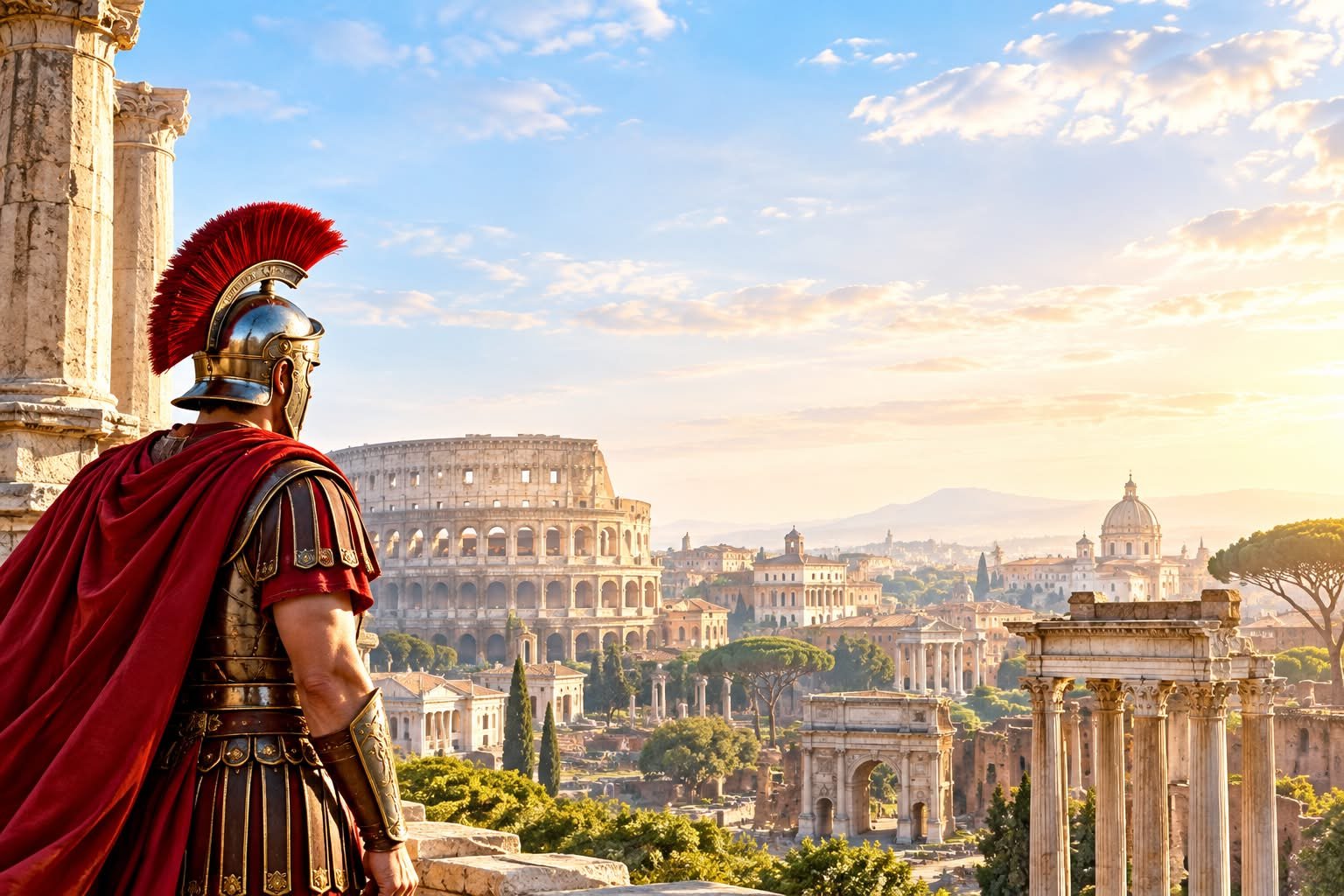
Rome did not fall in a single day. The famous date AD 476 marks the deposition of Romulus Augustulus, traditionally regarded as the last Western Roman emperor, by the Germanic military leader Odoacer. But the collapse of Roman authority in the West was a long process extending over generations. Political instability, civil wars, economic problems, declining tax revenues, military pressures, population movements and the increasing power of non-Roman military groups all interacted. Rome had faced invasions and crises before and survived them; what changed in the fifth century was the empire’s declining ability to recover from repeated shocks. The loss of important territories—especially the wealthy province of North Africa—damaged the Western government’s financial capacity, while powerful generals and federated military groups increasingly exercised authority that had once belonged to the emperor. Thus, 476 was more a symbolic endpoint than a single catastrophic moment.
The greatest strength of Rome was its ability to organize power on an enormous scale. The Romans combined a disciplined military system with taxation, roads, cities, law, administration and infrastructure. At its greatest extent in the second century, the Roman frontier system stretched for thousands of kilometers, from Britain across Europe and around the Mediterranean and North Africa. Roman roads were not merely transportation routes: they moved armies, officials, merchants and information. The Via Appia, begun in 312 BC, illustrates how military infrastructure eventually became an engine of commerce and urban development. Roman law and citizenship also provided mechanisms for incorporating diverse populations into a common political system. Rome’s extraordinary achievement was therefore not simply conquest; it was the construction of institutions capable of administering territories containing many languages, religions and peoples.
But the same system contained serious weaknesses. An empire of enormous size required enormous resources to defend and administer. Political succession was frequently unstable, and civil wars could consume the very military resources needed to protect the frontiers. Economic pressures intensified as territories were lost and taxation became increasingly burdensome. Inflation, declining revenues and disruptions to trade weakened the state, while the Western Empire gradually became more dependent on powerful military commanders and federated groups whose interests did not always coincide with those of the imperial government. External migrations and invasions were therefore important, but they should not be viewed as the sole explanation. The Huns, Goths, Vandals and other peoples applied enormous pressure to a system that was already experiencing internal difficulties. Rome’s central weakness was ultimately the erosion of the state’s capacity to convert its immense resources into effective, stable political authority.
Which countries today resemble Rome? No modern nation is a direct equivalent of the Roman Empire, and historical comparisons must be used carefully. Some modern states share individual characteristics with Rome rather than reproducing the Roman system. The United States, for example, has historically combined a large economy, worldwide military reach, extensive infrastructure and a network of alliances; China combines a very large population, centralized state institutions, extensive infrastructure and a long tradition of administrative organization. The European Union resembles Rome in a different respect: it brings together numerous peoples, languages and legal traditions within a broad political and economic framework, although it is not an empire and its institutions operate on fundamentally different principles. These comparisons are analytical analogies—not claims that today’s countries are repeating Rome’s history. Rome itself was also changing continuously, and the Eastern Roman Empire survived in Constantinople for almost another thousand years after the Western imperial government disappeared.
The question of who the Romans’ descendants are is more complicated than simply naming one modern nation. Modern Italians are among the populations with substantial historical continuity from the populations of ancient Italy, but the ancient Roman population itself was diverse and changed dramatically as the empire expanded. Romans incorporated people from Gaul, Iberia, North Africa, the Balkans, Anatolia, Syria and many other regions. The Romance languages—Italian, French, Spanish, Portuguese, Romanian and others—are among the clearest linguistic descendants of Latin and therefore constitute one of Rome’s most visible living legacies. Romanian is particularly notable because it developed from the Latin spoken in the former Roman province of Dacia, although modern Romanian ancestry, like that of other European peoples, reflects many later migrations and population mixtures. The Eastern Roman—or Byzantine—Empire also remained Roman in its own political identity until 1453, when Constantinople fell to the Ottoman Empire. Modern Greeks inherited significant Byzantine and Roman cultural traditions, but neither Greeks nor Italians can accurately be described as the single “direct descendants” of all Romans. Modern populations are the result of centuries of migration, intermarriage and cultural transformation.
What, then, did Rome leave for posterity—and what can we learn from it? Rome left an extraordinary inheritance: Roman law, Latin and the Romance languages, republican political concepts, citizenship, engineering, roads, bridges, aqueducts, urban planning, architecture, military organization, administrative practices and an enduring model of government over diverse populations. Roman institutions also influenced later European states, Christianity and the development of Western legal and political traditions. UNESCO describes Rome’s historical influence as extending particularly into law, language, literature, architecture, technology and urban planning. The most important lesson may be that great power is not sustained by military strength alone. Institutions, financial health, political legitimacy, competent administration, infrastructure and the ability to integrate different populations are equally important. Rome demonstrates both sides of state power: a civilization can build roads that survive for two millennia and laws that influence modern societies, yet still lose political control when its institutions can no longer respond effectively to accumulating pressures. Rome disappeared as a Western imperial government, but its civilization did not disappear. In many respects, Rome lost its empire but won an extraordinary afterlife.
References:
Gibbon, Edward. The History of the Decline and Fall of the Roman Empire. 6 vols. London: Strahan & Cadell, 1776–1788. The foundational, though now dated, narrative.
• Heather, Peter. The Fall of the Roman Empire: A New History of Rome and the Barbarians. Oxford: Oxford University Press, 2005. A leading modern account emphasizing the role of outside groups.
• Goldsworthy, Adrian. The Fall of the West: The Death of the Roman Superpower. London: Weidenfeld & Nicolson, 2009. A military and political narrative.
• Rostovtzeff, M. The Social and Economic History of the Roman Empire. 2nd ed. Oxford: Clarendon Press, 1957. A classic study of economic decline.
• Jones, A. H. M. The Later Roman Empire, 284–602: A Social, Economic, and Administrative Survey. 3 vols. Oxford: Blackwell, 1964. The definitive administrative and economic study.
• Brown, Peter. The World of Late Antiquity, AD 150–750. London: Thames & Hudson, 1971. A transformative work that reframed the period as one of transformation, not just decline.
• Cameron, Averil. The Mediterranean World in Late Antiquity, AD 395–700. 2nd ed. London: Routledge, 2012. A comprehensive survey.
[3] Roman Strengths: Infrastructure, Law, and Administration
• Boatwright, Mary T., Daniel J. Gargola, and Richard J. A. Talbert. The Romans: From Village to Empire. Oxford: Oxford University Press, 2004. A solid introduction to Roman institutions.
• Ando, Clifford. Imperial Ideology and Provincial Loyalty in the Roman Empire. Berkeley: University of California Press, 2000. On how Rome integrated diverse populations.
• Pharr, Clyde, et al., trans. The Theodosian Code and Novels and the Sirmondian Constitutions. Princeton: Princeton University Press, 1952. A key source for Roman law.
[4] Modern Comparisons and the Eastern Roman Empire
• Heather, Peter, and John Rapley. Why Empires Fall: Rome, America, and the Future of the West. New Haven: Yale University Press, 2023. A direct comparison between Rome and the modern West.
• Münkler, Herfried. Empires: The Logic of World Domination from Ancient Rome to the United States. Cambridge: Polity, 2007. A comparative study of empires.
• Millar, Fergus. A Greek Roman Empire: Power and Belief under Theodosius II (408–450). Berkeley: University of California Press, 2006. On the Eastern Empire’s continuity.
• Kazhdan, Alexander P., ed. The Oxford Dictionary of Byzantium. 3 vols. Oxford: Oxford University Press, 1991. The standard reference for Byzantine studies.
• Mango, Cyril. Byzantium: The Empire of New Rome. London: Weidenfeld & Nicolson, 1980. A classic introduction.
• Obolensky, Dimitri. The Byzantine Commonwealth: Eastern Europe, 500–1453. London: Weidenfeld & Nicolson, 1971.
[6] Roman Legacy: Law, Language, Architecture, and Engineering
• Stein, Peter. Roman Law in European History. Cambridge: Cambridge University Press, 1999. A concise overview of Roman law’s enduring influence.
• Ousterhout, Robert. Master Builders of Byzantium. Princeton: Princeton University Press, 1999. On the continuity of Roman engineering traditions.
• Claridge, Amanda. Rome: An Oxford Archaeological Guide. Oxford: Oxford University Press, 1998. A detailed guide to the physical legacy.
• UNESCO World Heritage Centre. Frontiers of the Roman Empire. https://whc.unesco.org/en/list/430/

Moise GARCON
Transparans Executive, Political Analyst