
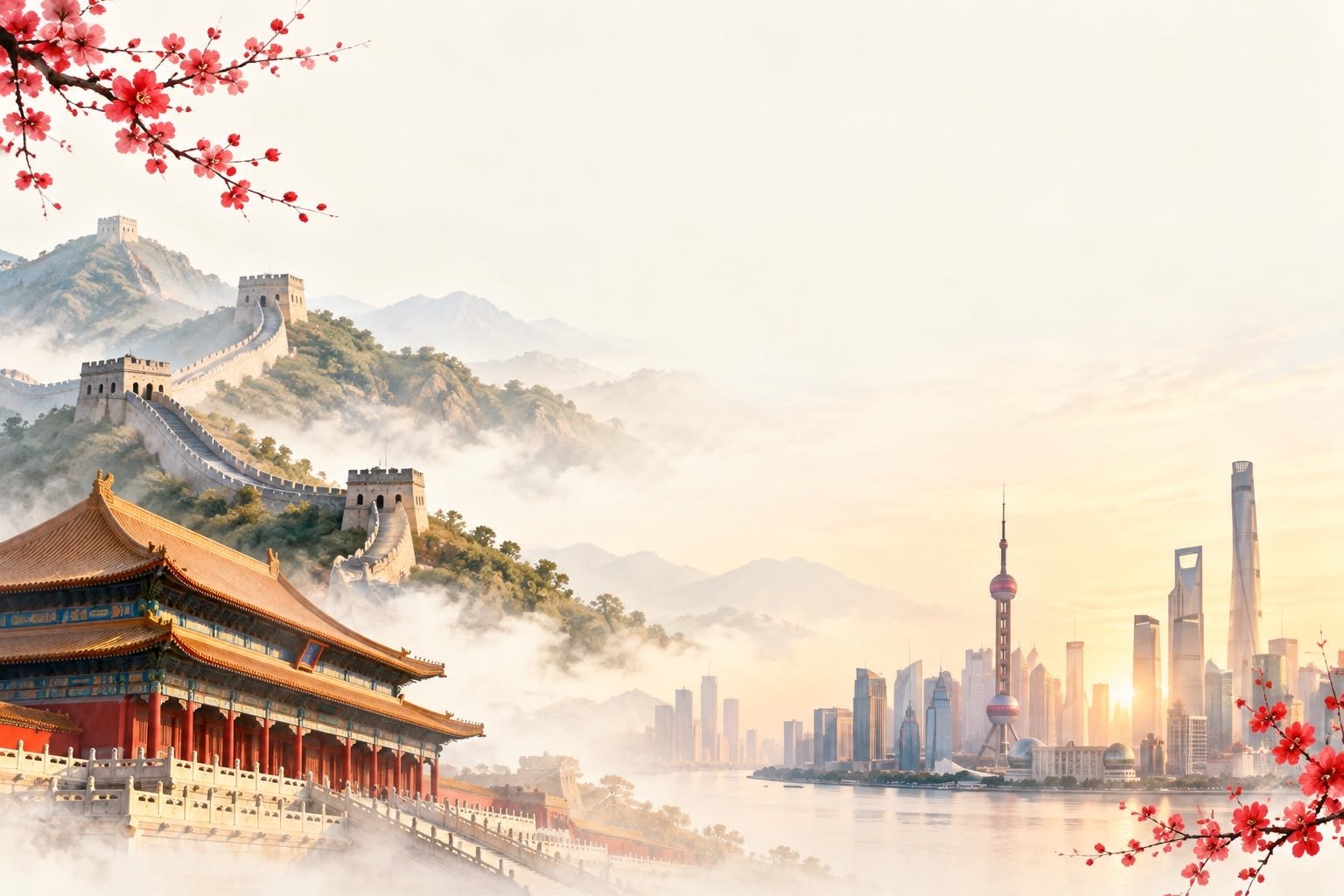
China is one of the rare civilizations whose history can be traced across several thousand years while still playing a central role in the international system of the 21st century. Its story is not a simple march from antiquity to modernity. It is a history of dynastic rise and collapse, political fragmentation and reunification, technological innovation, foreign invasion, revolution, economic experimentation and extraordinary adaptation. From the Shang and Zhou periods to the Qin and Han empires, from the Tang and Song golden ages to the Ming and Qing dynasties, China developed institutions, philosophies, technologies, agricultural systems and commercial networks that profoundly influenced East Asia. The Qin unification in 221 BCE was particularly important because it established an imperial political framework that would influence Chinese statecraft for roughly two millennia. Modern China is therefore a modern state built upon an exceptionally deep civilizational inheritance.
A civilization older than the modern nation-state
It is important to distinguish Chinese civilization from the contemporary People’s Republic of China, founded in 1949. The political entity that exists today is modern, but the civilization from which it emerged is ancient. The Shang dynasty, conventionally dated to roughly the second millennium BCE, left some of the earliest substantial written evidence from China, particularly the oracle-bone inscriptions used in ritual divination. After the Shang came the Zhou, followed by centuries of political competition that eventually produced the Qin unification. The Han dynasty then consolidated many of the institutions associated with imperial China.
Over subsequent centuries, China experienced periods of division as well as powerful reunifications under dynasties such as the Tang, Song, Yuan, Ming and Qing. The result was not uninterrupted political continuity, but remarkable civilizational continuity. Chinese writing, philosophy, administrative traditions, family structures, agricultural practices and political ideas survived dynastic transitions and repeatedly adapted to new circumstances. Confucian thought, for example, became deeply connected with education and government, while Chinese technological and commercial achievements contributed to developments far beyond China’s borders.
The significance of this history is enormous. China did not suddenly appear on the world stage in the 20th century. Its contemporary rise is taking place on top of a civilization that had already experienced empire, bureaucracy, urbanization, international trade, technological innovation and cultural transformation for centuries.
China knew slavery—but Chinese slavery was not Atlantic plantation slavery
The question of whether China knew slavery has a clear historical answer: yes. Scholarship on medieval and early-modern China documents slavery, hereditary servitude, coercive labor and other forms of dependency. Enslaved people could include war captives, people punished by the state, people sold into bondage and individuals born into inherited slave status. Chinese legal and social institutions developed their own categories and practices concerning unfree people.
But historical precision matters. Chinese slavery should not simply be placed in the same category as the racialized plantation slavery that later developed in the Atlantic world. Scholars emphasize that Chinese forms of bondage differed from the Roman legal model and from the racial plantation systems established by European colonial powers in the Americas. Race was not organized in China around the same Atlantic framework of European, African and Indigenous identities, and Chinese slavery developed within different legal, social and political institutions.
This distinction is particularly important when comparing China with Hispaniola and Haiti. Europeans transported enslaved Africans to the Caribbean as part of an expanding Atlantic system in which plantation production, colonialism, racial hierarchy and the international slave trade became closely interconnected. Chinese societies had already experienced various forms of human bondage long before that system emerged. At the same time, recognizing slavery in Chinese history does not diminish the particular historical character, scale or consequences of the Atlantic slave trade. The broader lesson is that slavery was a widespread human institution appearing in different societies under very different forms.
China’s road to modernity was long—and sometimes traumatic
China’s transition toward modernity did not begin on a single date. In many respects, the 19th century was the great shock that forced China to confront the rapidly changing international order. Military defeats, foreign intervention, unequal treaties, internal rebellions and growing economic pressure exposed weaknesses within the Qing imperial system. Reformers increasingly debated how China could preserve its civilization while acquiring the military, scientific, educational and economic capabilities necessary to compete with industrial powers.
The 1911 Revolution ended imperial rule and established the Republic of China, but political instability, warlordism, Japanese invasion and civil war prevented the country from immediately achieving stable modernization. The Communist victory in 1949 produced another profound transformation. Under Mao Zedong, China pursued a socialist economic and political model that included collectivization and central planning. The results were mixed and included major social and economic upheavals.
The decisive economic turning point came after 1978, when Deng Xiaoping and the Communist Party launched the reform-and-opening era. China gradually introduced agricultural reforms, expanded markets, permitted greater private and collective economic activity, established Special Economic Zones, attracted foreign investment and integrated itself into global trade. The transformation was extraordinary. According to the World Bank, close to 800 million people were lifted above the international extreme-poverty line over the following four decades. (World Bank)
China therefore demonstrates that modernization does not necessarily follow one predetermined Western model. It combined political continuity under Communist Party rule with extensive market experimentation and integration into global capitalism. The result was one of the most consequential economic transformations in modern history.
Is China really communist?
The answer depends on whether we are describing China’s political system or its economic system.
Politically, China is unquestionably governed by the Communist Party of China. China’s Constitution defines the People’s Republic as a socialist state and identifies Communist Party leadership as a defining feature of socialism with Chinese characteristics. The country’s political institutions operate under Communist Party leadership. (State Council of China)
Economically, however, contemporary China is very different from the centrally planned Soviet model of the mid-20th century. China officially describes its economy as a “socialist market economy.” Its Constitution recognizes public ownership as fundamental and identifies the state-owned sector as an important component, while also permitting diverse forms of ownership and explicitly establishing a socialist market economy. (State Council of China)
That produces a system that is difficult to fit neatly into the traditional categories of “communist” and “capitalist.” China combines one-party socialist political rule with markets, private enterprise, foreign investment, entrepreneurship, international trade and substantial state ownership. The more precise description is therefore: a Communist Party-led socialist state with a market-oriented mixed economy.
China’s experience also challenges the assumption that economic markets necessarily produce the same political institutions everywhere. China opened large portions of its economy to market forces without abandoning one-party political rule. That combination is one of the defining characteristics of the Chinese model.
Could China become the world’s leading superpower?
China already possesses many attributes of a major global power. It has one of the world’s largest economies, an enormous manufacturing base, advanced technological capabilities, a large military, nuclear weapons, a permanent seat on the United Nations Security Council and extensive commercial relationships around the world. The United Nations continues to list China among the five permanent members of the Security Council. (United Nations)
But becoming the world’s predominant power is not inevitable. China’s economic rise has entered a more complicated phase. World Bank data put China’s 2025 GDP at approximately $19.5 trillion in current U.S. dollars, with population at about 1.41 billion and population growth at -0.2 percent. (World Bank Open Data) The World Bank also identifies demographic aging, a declining workforce, weaker domestic demand, property-sector difficulties, high debt and slower productivity growth as important challenges. Its July 2026 economic update projected Chinese growth of approximately 4.4 percent for 2026 and 4.3 percent for 2027. (World Bank)
This does not mean that China’s rise has ended. It means that the next stage will be different from the spectacular expansion that followed 1978. The central question is increasingly whether China can move from an economy powered heavily by investment, manufacturing and exports toward one driven more by productivity, innovation, domestic consumption and high-value services. The World Bank’s current assessment describes China’s next phase as a transition toward more productivity-led and consumption-driven growth. (World Bank)
China’s real historical significance
The comparison with Rome and the United States is tempting, but history rarely repeats itself in identical form. Rome built an imperial system around the Mediterranean and eventually fragmented. The United States emerged as a continental republic, industrial power and global military and financial center. China is following neither path exactly.
China’s importance lies precisely in the fact that it represents something different: an ancient civilization operating through a modern nation-state, a revolutionary political system that embraced markets, and a developing country that within several decades became one of the central economic and geopolitical powers of the world.
The ultimate question is therefore not simply whether China will “replace” America. It is whether China can continue converting its enormous population, industrial capacity, technological capabilities and civilizational resources into sustainable national power while managing demographic, economic, environmental and geopolitical constraints.
History gives China an extraordinary foundation. But history does not guarantee the future.
China’s long road—from the Shang inscriptions to the Qin Empire, from the imperial dynasties to revolution, and from economic isolation to global integration—is ultimately a story about adaptation. Its greatest strength may not be that China has remained unchanged for thousands of years. It is that China has repeatedly changed while preserving enough continuity to remain recognizably Chinese.
That may be the most important lesson of China’s rise: great powers are not created only by size or wealth. They are created by the ability to adapt to changing historical conditions.
References:
– John K. Fairbank & Merle Goldman, China: A New History — broad history from ancient China through the modern period.
– Mark Edward Lewis, The Early Chinese Empires: Qin and Han — particularly useful for understanding the formation of imperial China.
– Patricia Buckley Ebrey, The Cambridge Illustrated History of China — accessible overview of Chinese political and cultural history.
-Jonathan D. Spence, The Search for Modern China — major reference for China’s transition from empire to modern state.
– Pamela Kyle Crossley, “Slavery in Early Modern China,” in The Cambridge World History of Slavery — important for understanding Chinese slavery and its differences from other systems.
– Don J. Wyatt, “Slavery in Medieval China,” in The Cambridge World History of Slavery — examines hereditary slavery, war captivity, punishment and other forms of bondage in medieval China.
– David Brion Davis, Inhuman Bondage: The Rise and Fall of Slavery in the New World — useful for placing Atlantic slavery in comparative historical context.
– World Bank, Four Decades of Poverty Reduction in China — evidence on China’s economic transformation and poverty reduction.
Moise GARCON
Transparans Executive and Political Analyst