
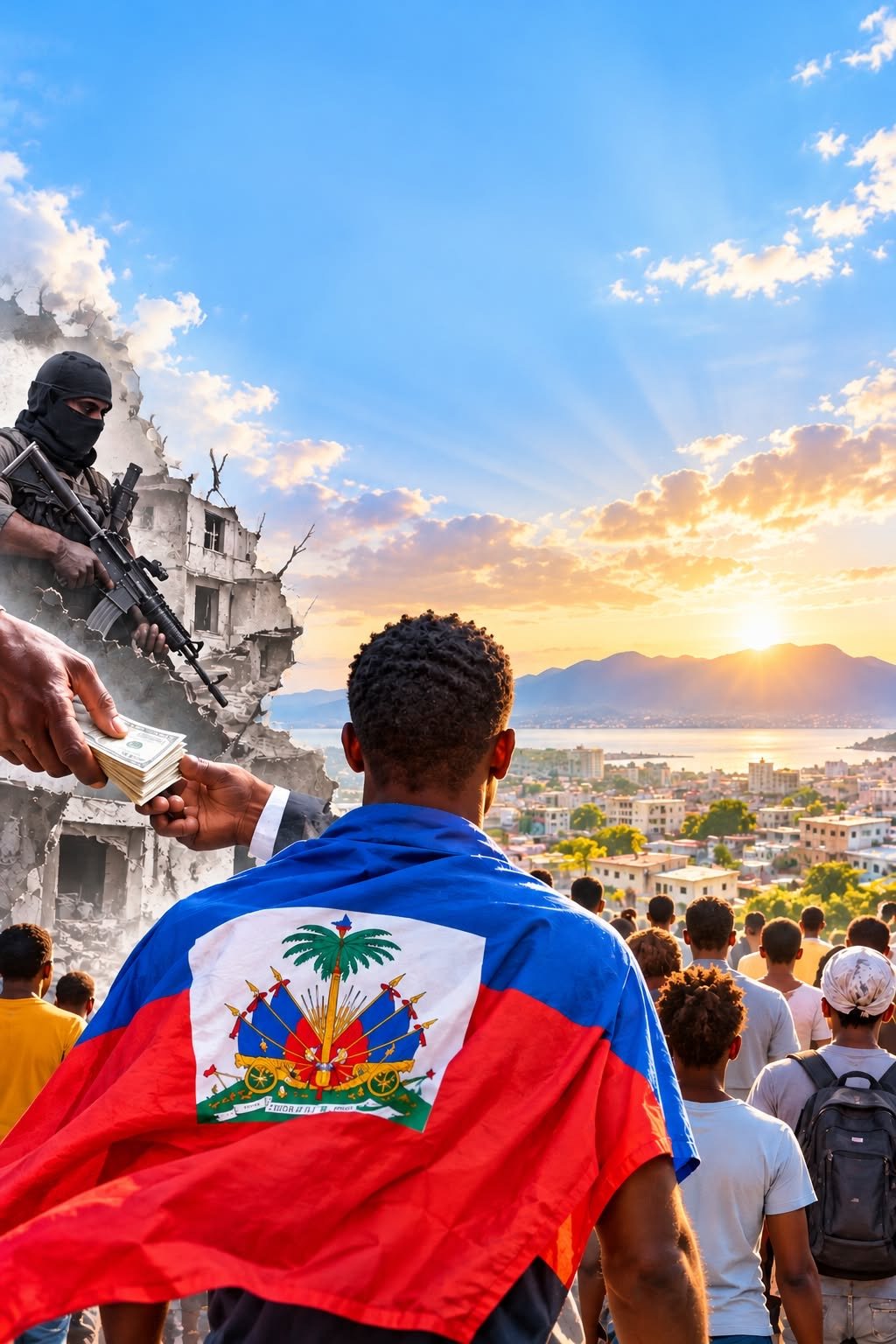
In Haiti, the demand for change is unmistakable. It echoes through protests, dominates social media, and fuels conversations in homes, workplaces, and communities across the country and throughout the diaspora. People want security, justice, accountable leadership, and a government capable of delivering a better future.
Yet, between the demand for change and the actions required to achieve it lies a troubling contradiction. While corrupt political leaders, powerful economic interests, and armed gangs bear enormous responsibility for Haiti’s collapse, the country must also confront a difficult question: What role do ordinary citizens play in sustaining the very system they want to change?
This question is not about blaming an entire population for a crisis it did not create. It is about recognizing that, alongside the actions of those who exploit the country, certain individual and collective behaviors can allow dysfunction to survive.
The Contradiction Between Demanding Change and Supporting It
Many Haitians want a different political system, yet relatively few are willing to make the sustained commitment that meaningful political change requires. Political parties often struggle to attract active members, maintain grassroots organizations, and secure the modest financial contributions necessary to operate independently.
Citizens frequently express dissatisfaction with politicians but remain disengaged from the organizations and movements that could offer alternatives. Others join political parties during moments of excitement or in anticipation of personal benefits, only to disappear when participation requires time, sacrifice, discipline, or financial support.
This creates a dangerous vacuum. When citizens withdraw from organized political life, those with money, influence, and access to public resources gain an even greater advantage. The political arena becomes easier to dominate by established interests, while reform-minded citizens struggle to build the structures necessary to compete.
Democracy cannot function on criticism alone. It requires participation, organization, accountability, and a willingness to support credible alternatives before they acquire power—not merely celebrate them after they win.
A population that demands political change but refuses to invest in the process risks leaving the future in the hands of those who benefit from the status quo.
When Convenience Becomes Complicity
The contradiction extends beyond politics. Corruption is widely condemned in public, yet it can be quietly tolerated or encouraged in everyday life.
Some citizens who denounce corrupt officials may nevertheless turn to personal connections, unofficial payments, or privileged access when they need a document processed, a problem resolved, or a service delivered more quickly. In such circumstances, the principle of fairness is sacrificed for immediate convenience.
These individual decisions may appear insignificant when considered separately. Collectively, however, they help normalize a culture in which rules are respected only when they are convenient and public institutions are treated as obstacles to bypass rather than systems to reform.
The result is a vicious cycle. Officials exploit their positions because they expect little resistance. Citizens circumvent the rules because they have lost confidence in the institutions. Each side reinforces the other’s behavior, and the public interest becomes the casualty.
It is important to recognize that people sometimes resort to informal arrangements because institutions are dysfunctional, services are unavailable, or survival leaves them with few alternatives. Responsibility, therefore, cannot be distributed equally between those who abuse public office and those who struggle to navigate a broken system.
Nevertheless, necessity should not become a permanent justification for practices that undermine fairness and accountability. If Haiti is to build institutions that serve everyone, citizens must increasingly demand equal treatment rather than seek exceptions for themselves.
The Dangerous Accommodation with Armed Gangs
Haiti’s security crisis presents an even more difficult challenge. Armed gangs extort businesses, impose illegal tolls, restrict movement, terrorize communities, and undermine the authority of the state. Their violence has forced countless families from their homes and deprived entire communities of basic freedoms.
Under these circumstances, paying an imposed toll or complying with an armed group’s demands cannot automatically be interpreted as support for criminality. Many people comply because refusing may mean death, injury, kidnapping, or the destruction of their livelihoods. Survival under threat is not the same as voluntary complicity.
But a distinction must be made between those who submit under coercion and those who knowingly collaborate with criminal networks for financial gain, political advantage, protection, or personal convenience.
Where individuals voluntarily provide intelligence, money, logistical assistance, political cover, or other material support to armed groups, they help strengthen the very organizations that terrorize their communities. Such cooperation can make the restoration of public security more difficult and deepen the population’s dependence on criminal power structures.
There is also a broader social challenge. When communities lose confidence that collective action and legitimate institutions can protect them, accommodation with armed groups may begin to appear inevitable. Fear encourages silence, silence isolates those who resist, and isolation allows criminal control to expand.
Breaking this cycle cannot mean demanding that unprotected citizens confront heavily armed groups on their own. The state must provide credible protection, restore access to justice, and create safe channels through which people can report crimes and resist extortion. Community solidarity, responsible business practices, and support for lawful institutions must be accompanied by meaningful protection for those who participate.
The objective is not to shame people struggling to survive. It is to prevent survival strategies from becoming a permanent social arrangement in which criminal groups exercise authority and entire communities are denied the possibility of a different future.
Elections Are Not Enough
The same contradictions threaten Haiti’s political future.
Many citizens want elections, but an election alone cannot guarantee democratic renewal. The integrity of the process, the quality of the candidates, the independence of electoral institutions, and the willingness of citizens to defend fair competition are equally important.
Too often, political impatience encourages people to gravitate toward whoever appears most powerful, best financed, or most likely to win. Some voters support candidates because of personal connections, immediate benefits, or expectations of access to public resources rather than a serious assessment of their competence, integrity, and program.
The desire to join the winning side can become more important than the desire to choose the right leadership.
Meanwhile, candidates with credible ideas but limited resources may struggle to gain visibility and public support. When political success depends primarily on money, influence, patronage, or intimidation, principled alternatives face an uphill battle.
Citizens cannot demand honest government while rewarding dishonesty at the ballot box. Nor can they expect better leadership if they refuse to examine candidates critically, challenge electoral manipulation, and support transparent political processes.
This does not mean that every unsuccessful candidate is necessarily principled or that every popular candidate is unfit to lead. It means that electoral choices must be guided by evidence, competence, integrity, and a clear vision for the country—not merely by momentum or the prospect of personal advantage.
The purpose of an election should not be simply to put someone in power. It should be to choose leadership capable of serving the public interest and accountable to the people.
From Public Outrage to Civic Responsibility
If Haiti is to break this cycle, citizens must begin to see themselves not only as victims of the crisis but also as potential agents of change.
That responsibility must be exercised realistically, collectively, and without excusing the failures of those who hold power. Citizens cannot replace the state, and they should not be expected to assume the risks that public institutions are obligated to address. But they can influence the political and social environment in which leaders operate.
Several practical commitments could help move the country forward.
First, build stronger political organizations. Citizens who believe in reform should join credible parties, participate in internal decision-making, volunteer their skills, and contribute financially within their means. Political organizations cannot become effective instruments of change if they exist only during election campaigns.
Second, reject everyday corruption. Refusing to offer or demand improper payments, opposing favoritism, and insisting on fair procedures can help establish different expectations for public life. Where individuals cannot safely resist coercive demands, they deserve protection rather than condemnation.
Third, refuse voluntary collaboration with criminal networks. Citizens and business owners should avoid providing discretionary financial, logistical, or political support to armed groups. At the same time, authorities and community institutions must develop safe, credible alternatives for people subjected to extortion and intimidation.
Fourth, invest in political accountability. Citizens should evaluate candidates on their records, qualifications, policy proposals, and ability to deliver measurable results. They should demand transparency before elections and continue monitoring elected officials afterward.
Fifth, replace political impatience with long-term commitment. Institutional reform takes time. Building credible parties, developing capable leaders, strengthening civic organizations, and restoring public trust require consistent work. Supporting a candidate simply because that candidate appears likely to win may offer short-term satisfaction while reproducing the conditions that caused the crisis.
These commitments will not solve Haiti’s problems overnight. But they can help create the civic foundation without which political reform is unlikely to endure.
The Diaspora Must Also Look in the Mirror
Haiti’s transformation is not solely the responsibility of those living within its borders. The diaspora has an important role to play through financial support, professional expertise, civic engagement, investment, and participation in debates about the country’s future.
Yet the diaspora must also guard against reproducing the same habits it criticizes at home: financing political personalities without demanding accountability, supporting candidates based on personal loyalties, or treating political engagement as a temporary response to a national emergency.
Financial contributions should strengthen transparent institutions, credible civic initiatives, and organizations capable of demonstrating results. Professional expertise should be used to develop solutions, improve governance, and support sustainable economic opportunities.
The relationship between Haiti and its diaspora must evolve beyond expressions of solidarity into a structured partnership built on responsibility, transparency, and measurable impact.
Change Begins with Accountability—Especially at the Top
Holding citizens accountable for their choices must never become an excuse to absolve Haiti’s political and economic elites, public officials, or armed criminals.
Those who occupy positions of power have greater responsibilities because they possess greater authority and resources. Officials who steal public funds, politicians who sponsor violence, business interests that finance criminal networks, and armed groups that terrorize communities must be held accountable for their actions.

The state remains responsible for protecting citizens, enforcing the law fairly, delivering essential services, and creating conditions in which people can participate in public life without fear.
But leadership accountability and civic responsibility are not competing ideas. They are complementary requirements for national recovery. Citizens must demand a functioning state, while refusing to normalize the behaviors that weaken it. Leaders must serve the public, while citizens must organize to ensure that public service is not reduced to a slogan.
Neither side can substitute for the other.
The Choice Haiti Must Make
Haiti will not be transformed by outrage alone, nor will it be rescued by a single leader, a political party, or an election conducted without deeper institutional change.
The country needs citizens who are prepared to move beyond criticism toward sustained participation; voters who value competence and integrity over political convenience; organizations that can survive beyond election cycles; and institutions capable of protecting those who stand against corruption and criminality.

Above all, Haitians must confront the gap between what they demand publicly and what they are willing—or able—to support in practice.
The challenge is not to condemn an entire population already burdened by insecurity, poverty, and institutional failure. It is to distinguish between those trapped by coercion and those who willingly exploit the system, between justified disillusionment and avoidable disengagement, and between short-term survival and the long-term choices required to rebuild a nation.
The silent majority must find ways to become an organized, principled, and persistent force for change. That means supporting credible leadership, strengthening civic institutions, rejecting corruption wherever it can safely be resisted, and demanding that political power serve the public rather than private interests.
Haiti’s future will depend on more than identifying those responsible for its suffering. It will depend on building a society in which corruption is no longer rewarded, criminal power is no longer normalized, and democratic participation extends far beyond election day.
The question is no longer simply who is destroying Haiti. It is whether enough Haitians are prepared to organize, sacrifice, and work together to build something better.
The demand for change is already loud. The task now is to turn that demand into sustained, collective action.
Moise GARÇON
Exclusive excerpt from the forthcoming book: “Haiti: From Survival to Emergence.”